

High-Quality Early Learning and Child Care
Choosing High-Quality Child Care: A Guide for Parents
This guide provides important information for parents to understand what to look for and what to ask when looking for child care in Alberta. It includes information for several indicators of quality, including:
Children and families are valued partners;
Educators are skilled, caring, and knowledgeable;
The environment is inviting, purposeful, and inclusive; and
Programs are connected to the community.
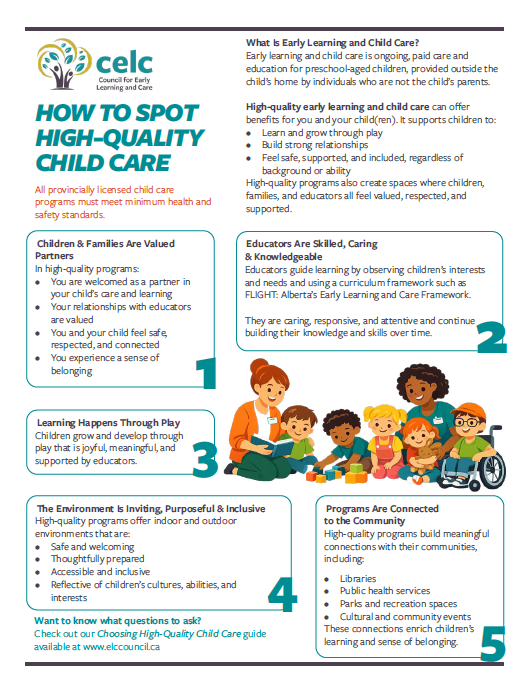
How to Spot High-Quality Child Care
This one-sheet provides a brief introduction to early learning and child care, providing details on benefits for your family and your child(ren). It also helps parents understand what to look for when assessing quality, including indicators in:
Children and families are valued partners;
Educators are skilled, caring, and knowledgeable;
Learning happens through play;
The environment is inviting, purposeful, and inclusive; and
Programs are connected to the community.
FAQ - High-Quality Early Learning and Childcare
-
Alberta, in partnership with the federal government under the Canada-Wide Early Learning and Child Care (CWELCC) agreement, is now in its fifth year of building a system of early learning and child care (ELCC). As this system matures, it must incorporate features that ensure continuous improvement and public accountability so that parents, taxpayers, and decision makers can be confident that the system is delivering high quality ELCC.
-
Licensing plays a necessary role in Alberta’s ELCC system. It exists to ensure that all regulated programs meet essential requirements for health, safety, staffing, and supervision. It provides a foundational level of oversight and accountability, which is essential. However, additional quality assurance mechanisms are needed to ensure nurturing, inclusive, and responsive environments.
Licensing focuses on whether programs are operating safely and legally.
Quality standards and assurance processes focus on whether programs are supporting the optimal development of children.
In a system now built on public investment, Albertans expect more than compliance; they expect programs that are inclusive, equitable, and consistently high in quality. That’s why we need additional tools and standards that can assess, support, and improve quality across all licensed programs.
-
High-quality ELCC is about more than regulatory compliance. It is grounded in evidence-informed practices that nurture every dimension of a child’s development, personal, social, emotional, cognitive, and physical, while supporting the well-being of families and communities.
According to the CELC position paper, Quality in Early Learning and Care: Recommendations for Action, quality in ELCC is multi-dimensional. It is shaped by four interconnected components:
Structural Quality: The foundational elements of a program, such as staff quQualialifications, child-to-educator ratios, safety standards, and inclusive curriculum use.
Process Quality: What happens day-to-day: the interactions, relationships, and learning experiences that shape children’s development.
Outcome Quality: The lasting impact on children, families, and communities, from well-being and school readiness to broader social and economic benefits.
Systemic Quality: System-wide practices and policies that apply to the entire system of ELCC and that ensure high quality and continuous improvement.
-
High-quality ELCC goes well beyond meeting minimum licensing standards. It is defined by how well a program supports every dimension of a child’s development through evidence-informed practices, inclusive environments, and strong relationships.
According to the Council for Early Learning and Care (CELC), quality also includes how systems support educators, ensure equity, and engage families and communities. CELC is committed to advancing quality indicators and policy improvements at both the provincial and national levels so that all young children and their families have access to inclusive, affordable, accessible, and high-quality ELCC.
-
As access to child care expands and costs come down, we must also focus on the aspects of quality and inclusion in early learning and child care. Families and communities deserve to know that programs receiving public dollars are truly supporting children’s development and inclusion.
Quality standards define what high-quality ELCC looks like.
Quality assurance refers to the processes used to ensure that services consistently meet those standards.
Given the scale of public investment in ELCC, and the profound impact on children, families, and communities, Alberta needs both clear quality standards and strong quality assurance processes.
Together, they will provide
Transparency: Families can make informed choices
Support: Educators and operators receive tools to improve
Consistency: Children benefit from quality regardless of location or operator type
Accountability: Public funds deliver public value
-
ELCC programs in Alberta are delivered through a mix of for-profit businesses, non-profit organizations, and publicly operated services. This difference can raise important questions about values and policy direction.
Regardless of who operates the program, what matters is that all ELCC settings are supported by clear, evidence-based quality standards and quality assurance processes. These common standards and processes create improved consistency and fairness, and ensure all children have access to nurturing, inclusive, and enriching care no matter where they are enrolled.